

Trucking Cost Per Mile: How To Calculate It


Most owner-operators and small fleets know exactly what a load pays, but far fewer know exactly what it costs them to haul it in the first place. Without that number, a rate that looks fine on the rate con can quietly lose money once the empty miles and your own costs are taken into account, which most usually find out only when the month closes.
That’s what your trucking cost per mile (CPM) is designed to fix. It shows what it costs to move your truck one mile, so you can determine which rates fully cover your costs, which are worth negotiating, and which loads to turn down before you’ve booked them.
This guide shows how to calculate cost per mile with a simple formula and a worked example you can copy into your spreadsheet, then compares it to the 2026 benchmark and turns it into the lowest rate you should accept.
What Is Cost Per Mile in Trucking?
Cost per mile in trucking is the total cost of everything needed to run your truck over a period, divided by every mile driven in that same period.
It’s made up of three groups of costs: fixed costs you pay whether the truck moves or not, variable costs that rise with every mile, and driver pay. Keeping fixed vs variable costs apart matters, because fixed costs shrink per mile the more you drive, while variable costs stay roughly flat over time.
Owner-operators often ask whether cost per mile should include their own salary, and the answer is yes. If your pay isn’t in the math, your CPM only shows when the truck breaks even, not when you do. Book loads at that rate, and you’re effectively driving for free.
How To Calculate Cost Per Mile
To calculate the cost per mile, run a thorough audit of your expenses, and then add up your fixed costs, variable costs, and driver pay for one period, then divide the total by all the miles you drove in that same period, both loaded and empty.
The Cost Per Mile Formula
Cost per mile = (fixed costs + variable costs + driver pay) ÷ total miles driven
Here’s how to calculate CPM in trucking, step by step:
- Pick a period: Monthly works best, but average lumpy costs like tires, major repairs, and annual insurance or IRP payments over at least three months, so one really tough month doesn’t skew the results.
- Add up your fixed costs: For most, these include truck and trailer payments, insurance, permits and registration (IRP, IFTA, UCR), ELD and software subscriptions, parking, and accounting.
- Add up your variable costs: These include fuel, repairs and maintenance, tires, tolls, and DEF. Work out the fuel cost per mile separately, since it moves the most, dividing the diesel price by your MPG. At $6.29 a gallon and 6.5 MPG, fuel alone costs about $0.97 a mile.
- Add driver pay, including your own: For a company driver, that’s wages plus benefits and payroll taxes. For an owner-operator, it’s your draw plus self-employment tax and health insurance.
- Divide by total miles: Count every mile on the odometer, and don’t forget to include the empty ones that never show up on a rate confirmation.
Build a Simple Cost Per Mile Calculator in a Spreadsheet
The truth is, you don’t need some special cost per mile calculator app to get an accurate number. A simple cost per mile spreadsheet in your Excel or Google Sheets does the same job, with every input under your control, and the creative freedom to design it to your liking.
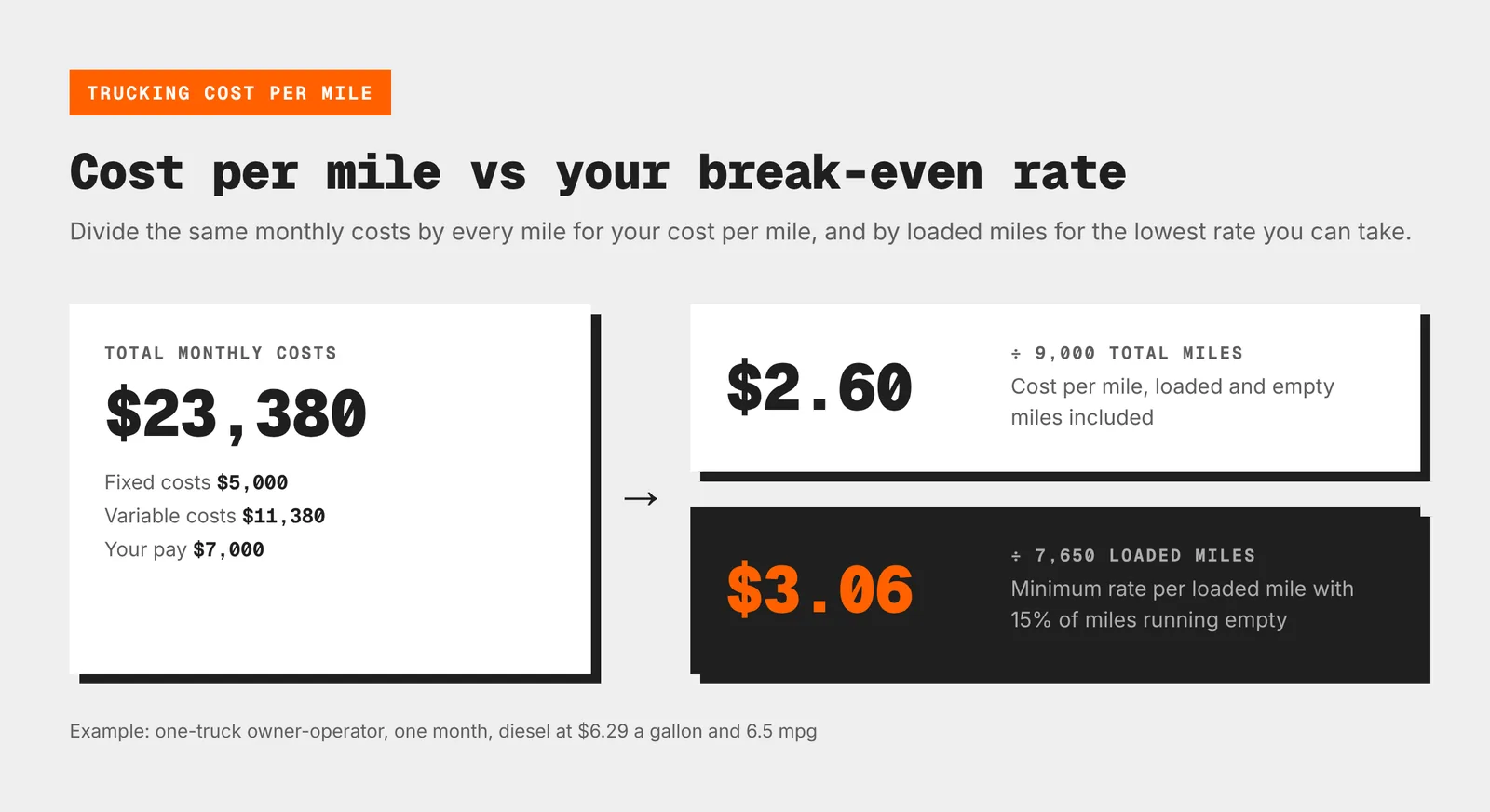
To show this as an example, below is an owner-operator cost per mile worksheet for one truck that drove 9,000 miles in a month (7,650 loaded, 1,350 empty):
| Cost | Monthly | Per mile |
|---|---|---|
| Truck payment | $2,400 | $0.267 |
| Trailer payment | $600 | $0.067 |
| Insurance | $1,400 | $0.156 |
| Permits and registration | $150 | $0.017 |
| ELD and software | $200 | $0.022 |
| Parking and accounting | $250 | $0.028 |
| Fixed costs | $5,000 | $0.556 |
| Fuel (1,385 gal at $6.29) | $8,710 | $0.968 |
| Repairs and maintenance | $1,800 | $0.200 |
| Tires | $450 | $0.050 |
| Tolls | $300 | $0.033 |
| DEF | $120 | $0.013 |
| Variable costs | $11,380 | $1.264 |
| Your pay (draw, taxes, health insurance) | $7,000 | $0.778 |
| Total | $23,380 | $2.60 |
To build it, simply list your costs in one column, put your monthly miles in a single cell, and divide each row by that cell.
While you’re at it, a neat addition to your spreadsheet would be one simple line under the total: fixed costs divided by 30. In this example, that’s about $167 a day, and it shows you what waiting a day for a load costs before you’ve paid yourself.
Average Cost Per Mile for Trucking in 2026
The average cost per mile for trucking was $2.336 in 2025, according to ATRI’s 2026 Operational Costs of Trucking, which is 3.4% more than the year before and the highest figure in the report’s history.
Here’s how it breaks down by cost line:
| Cost line | Per mile (2025) |
|---|---|
| Driver wages | $0.818 |
| Fuel | $0.482 |
| Truck and trailer payments | $0.400 |
| Repairs and maintenance | $0.215 |
| Driver benefits | $0.210 |
| Insurance | $0.106 |
| Tires | $0.050 |
| Tolls | $0.043 |
Keep in mind that these are fleet averages built around company drivers, and the fuel line reflects 2025 diesel prices. That’s why our worked example from before lands at $2.60, with fuel alone about twice ATRI’s figure. Location matters here too, as the Northeast averaged $2.52 a mile, compared to $2.23 in the South-Central region.
That’s why there’s no clear answer to what is a good cost per mile for a trucking company, as there are many factors in play, but it of course has to sit comfortably below what your lanes pay. If your insurance or maintenance cost per mile is far above ATRI’s, that’s the line to fix first.
Cost Per Mile vs Rate Per Mile: What To Charge
Cost per mile is what you spend to move the truck, while rate per mile is what the load pays you. Your rate has to beat your cost on every mile you drive, which also includes the empty miles to get to the load.
If you’re working out how to calculate rate per mile in trucking, just divide the total pay for the load (line haul plus fuel surcharge) by the miles driven. However, brokers quote rates on loaded miles, so add the deadhead to the trip before you compare that rate to your CPM.
A cleaner check is to turn your CPM into a minimum rate per loaded mile:
Minimum rate per loaded mile = total monthly costs ÷ loaded miles
In our example above, that’s $23,380 ÷ 7,650 loaded miles, or $3.06. Anything below that loses money once the empty miles are counted, even though the truck’s CPM is only $2.60. Your profit is whatever you charge above that minimum, so decide on the margin you want and check every lane’s rate against minimum plus margin.
How To Lower Cost Per Mile: Start With Empty Miles
The fastest way to lower your cost per mile is to cut the miles and days that earn nothing. According to that same ATRI report, 16.5% of non-tank truck miles ran empty in 2025, and every one of those miles burns fuel, tires, and your time with no revenue attached.
To better understand how much that matters, take our example truck and drop its deadhead from 15% to 10% on the same 9,000 miles. Its minimum rate now falls from $3.06 to $2.89 per loaded mile, which is a 17-cent cushion on every load it takes, without even changing a single cost line.
Idle days hurt in a similar way, because while the truck is parked waiting for a load, it drives no miles but still runs up about $167 a day in fixed costs.
Most empty miles come from booking the next load too late, and these are the habits that can help reduce them:
- Look for the reload a day or two before you unload, while there are still options near the drop-off.
- Search around the delivery point as well as on the way home. A short reposition to a strong market often beats a long run back empty.
- Know where every truck will be tomorrow. If you find out a truck is free only after the driver calls, you’re already late.
- Treat backhauls as part of the lane plan. A good front haul that leaves you stranded is worse than it looks on the rate confirmation.
Lower cruising speed, less idling, preventive maintenance, and yearly insurance shopping all trim cents per mile too, but none moves the number as much as filling those empty miles in the first place.
Find Reloads Earlier With Cargofy Planner and Load Hub
Cargofy is a logistics platform where AI digital workers handle the repetitive parts of freight work, like searching for loads, sending bids, and checking in with drivers, all while your team makes the final decisions.
For carriers looking to lower their cost per mile, most of that work goes into getting each truck’s next load lined up before it unloads and starts running empty.
The Planner shows what every truck is doing today and throughout the week in one calendar, including trips, idle time, repairs, and time off, resulting in 15% fewer empty miles on average, with every truck planned 48 hours ahead.
So if a truck unloads in Memphis tomorrow, the dispatcher can set up a search today for loads out of Memphis, and Planner will show the matches.
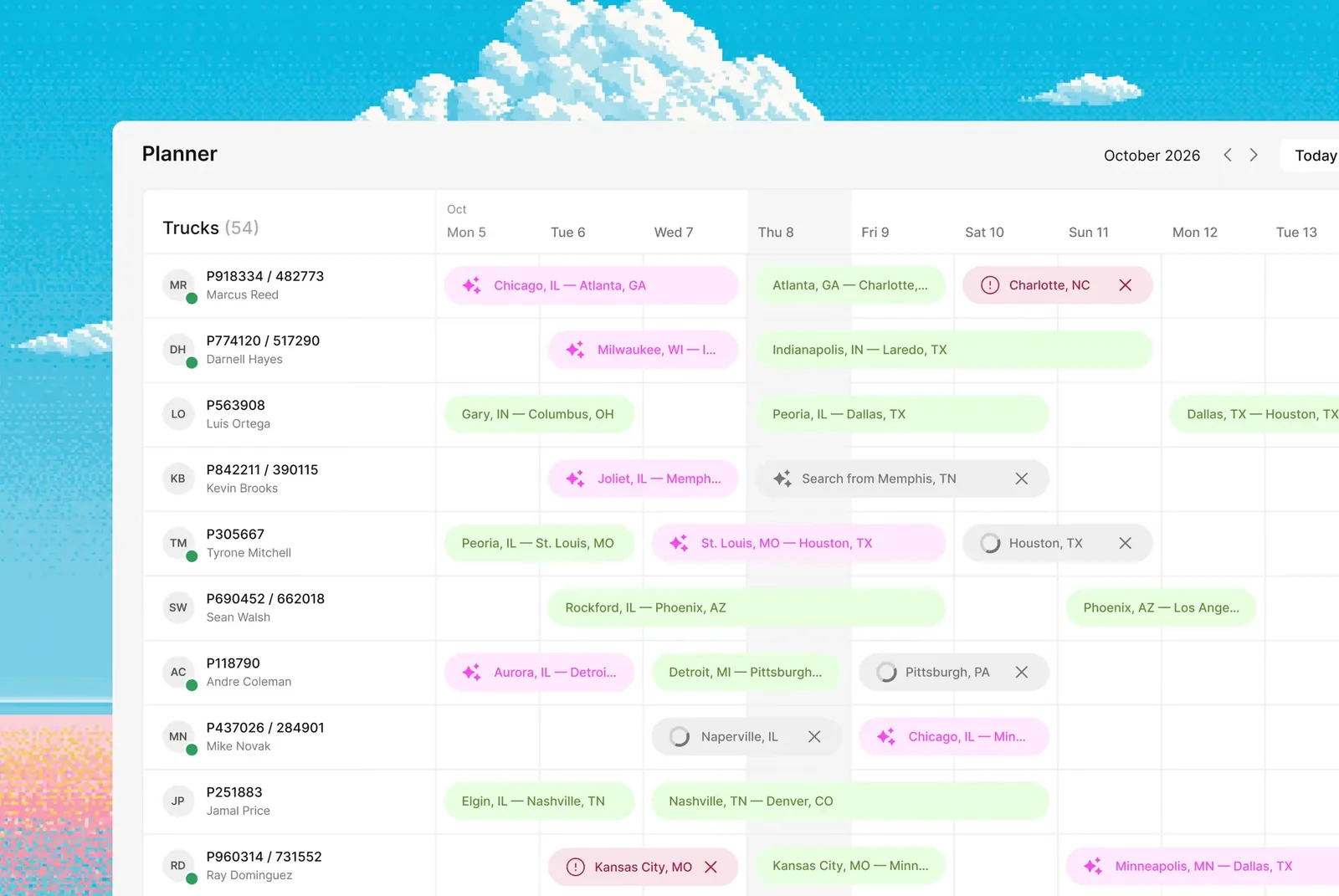
Load Hub then runs the search, pulling loads from your email, your connected load boards, and shippers on the Cargofy platform into one ranked table, so you’re not jumping between board tabs and inboxes. Saved lane alerts near your drop-off points keep running around the clock, and the Digital Worker can send the bid or booking request on a load right away.
Start on the free one-truck plan and line up your next load before your truck runs empty. Explore Load Hub →
Know Your Number Before the Next Rate Con
Your cost per mile is the number every rate decision should start from, and it only works if it includes your own pay and every empty mile. Build the sheet from last quarter’s numbers and update it monthly as fuel and repair bills come in. Once you know your minimum rate per loaded mile, check every rate con against it before you say yes. From there, the fastest way to improve the number is to cut the miles your truck drives empty.