

Best AI Dispatch Software For Trucking


A truck dispatcher rarely spends their entire workday on actual dispatching. Most of it goes to scanning load board tabs, calling back brokers about loads that are already gone, chasing drivers for ETAs, and retyping rate confirmations into their TMS. AI dispatch software takes on a huge chunk of that repetitive work, so dispatchers can spend more of their time on rate negotiations, driver relationships, and the judgment calls that need human expertise.
The labels in this category overlap a lot, since some tools are load search assistants for a single truck, others are full-on TMS platforms with AI built in, and a few plan freight across fleets of hundreds of trucks. This guide covers what AI dispatch software actually does in logistics, how to choose one, and the top six tools sorted by the part of the job they take off your dispatchers.
What Does AI Dispatch Software Do?
AI dispatch software automates the repetitive parts of truck dispatch, most notably — finding and scoring loads, contacting brokers and drivers, and moving data between email, load boards, and the TMS. In fact, some AI tools will even match drivers to loads, though, ideally, dispatchers should still approve any decisions that carry risk or big financial commitments.
In practice, the work of AI trucking dispatch software splits into four main jobs:
- Freight search and bidding: scanning load boards and broker emails, ranking loads against your lanes and rates, and then bidding, emailing, or calling about those that fit.
- Truck and driver matching: recommending which driver and truck should take a load based on location, hours, and equipment.
- Planning ahead: looking days out across the whole fleet to decide which loads to accept and where trucks are about to run empty miles.
- Calls, messages, and paperwork: check calls, appointment scheduling, ETA updates, and turning rate confirmations into loads.
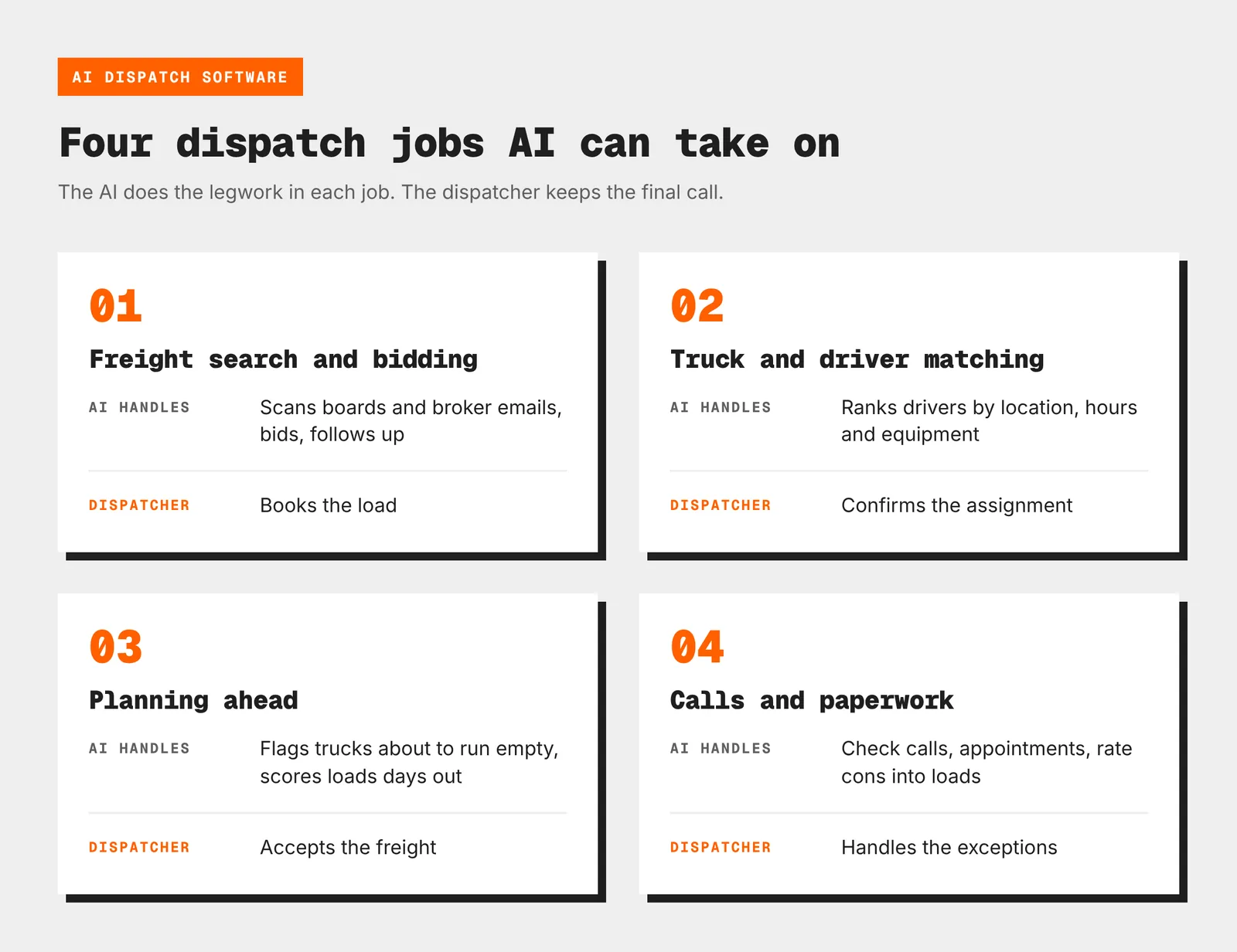
An AI dispatcher is a product, or an agent inside one, that does these tasks in the same channels a human dispatcher would normally use, like phone, email, text, and messengers.
While these tools handle most of the legwork, most of them keep a person in the loop for the final booking. For instance, Cargofy’s Digital Workers send the booking request and wait for the dispatcher to confirm it, and TruckSmarter transfers the driver in to confirm a phone booking.
That’s also why AI won’t replace truck dispatchers, since even though it can take over the volume of calls, emails, board refreshes, and data entry, things like pricing judgment, driver relationships, and exceptions are best handled by the professionals.
How To Choose the Best AI Dispatch Software for Your Fleet
Start with the job that takes up the most dispatcher hours from your team, and judge every product by how well it does that specific job. A tool that negotiates well with brokers won’t help much if your fleet runs dedicated contract freight and loses time on check calls.
Next, run these five checks before you book any demos:
- Fleet size and your TMS: owner-operators can work from an app, while fleets of 20 trucks or more usually need the AI to read from and write into their TMS.
- Where your freight comes from: load boards, broker emails, and contract shippers each need different connections, so always double-check which boards are supported.
- Channels: check whether the AI can make phone calls, send emails, and use WhatsApp or SMS, because most brokers and drivers won’t be eager to move to a new portal for you.
- Approval controls: you should get to decide what the AI does on its own, like sending a bid, and what waits for a person, like booking the load, and see a log of every action it took.
- Pricing model: prices are set per truck, per dispatcher seat, per action, or per load, so the same monthly bill on paper can buy very different amounts of work.
Top AI Dispatch Software for Trucking, Compared
Each tool below owns a different part of the dispatch job, so here’s a quick overview of where each one fits, followed by the full breakdown:
| Tool | Best for | What the AI handles | Starting price |
|---|---|---|---|
| Cargofy | Carriers, shippers, and brokers that run freight by phone, email and WhatsApp | Load search and bids, broker calls and emails, driver check calls, truck planning | Free for 1 truck, pay per task for fleets |
| Optimal Dynamics | Large truckload carriers and private fleets | Load acceptance, driver-to-load planning, freight sourcing | Quote after demo |
| PCS Software | Carriers with 25 to 1,000+ trucks open to a new TMS | Driver matching, load scoring, backhaul search | Quote after demo |
| Alvys | Growing and enterprise carriers and brokers moving to a new TMS | Driver recommendations, check calls, settlement prep, track-and-trace exceptions | Quote after demo |
| Numeo | Dispatch teams and carriers working from DAT and Truckstop | Load ranking, broker checks, email negotiation | Spot free, Pro from $9.99/dispatcher/mo |
| TruckSmarter Dispatch | Owner-operators | Load search, bids, broker emails and calls | Free, $49/mo unlimited |
1. Cargofy: Digital Workers for Load Search, Truck Planning, and Check Calls
Cargofy is a logistics platform with AI digital workers used by shippers, brokers, and carriers to run freight from quote to proof of delivery around the clock.
On the carrier side, the Digital Workers take on the time-consuming dispatch work — they search for loads, bid, call or email brokers, check in with drivers, and keep each truck’s plan current. Every action is logged to the worker that took it, and when something falls outside your limits, such as a rate below your floor, the worker flags the load and waits for a person to handle the rest.
The core is Load Hub, which pulls loads from your email, connected load boards (Direct Freight and Sylectus in North America, plus Timocom, Trans.eu, and others in Europe), and shippers on the Cargofy platform into one ranked table.
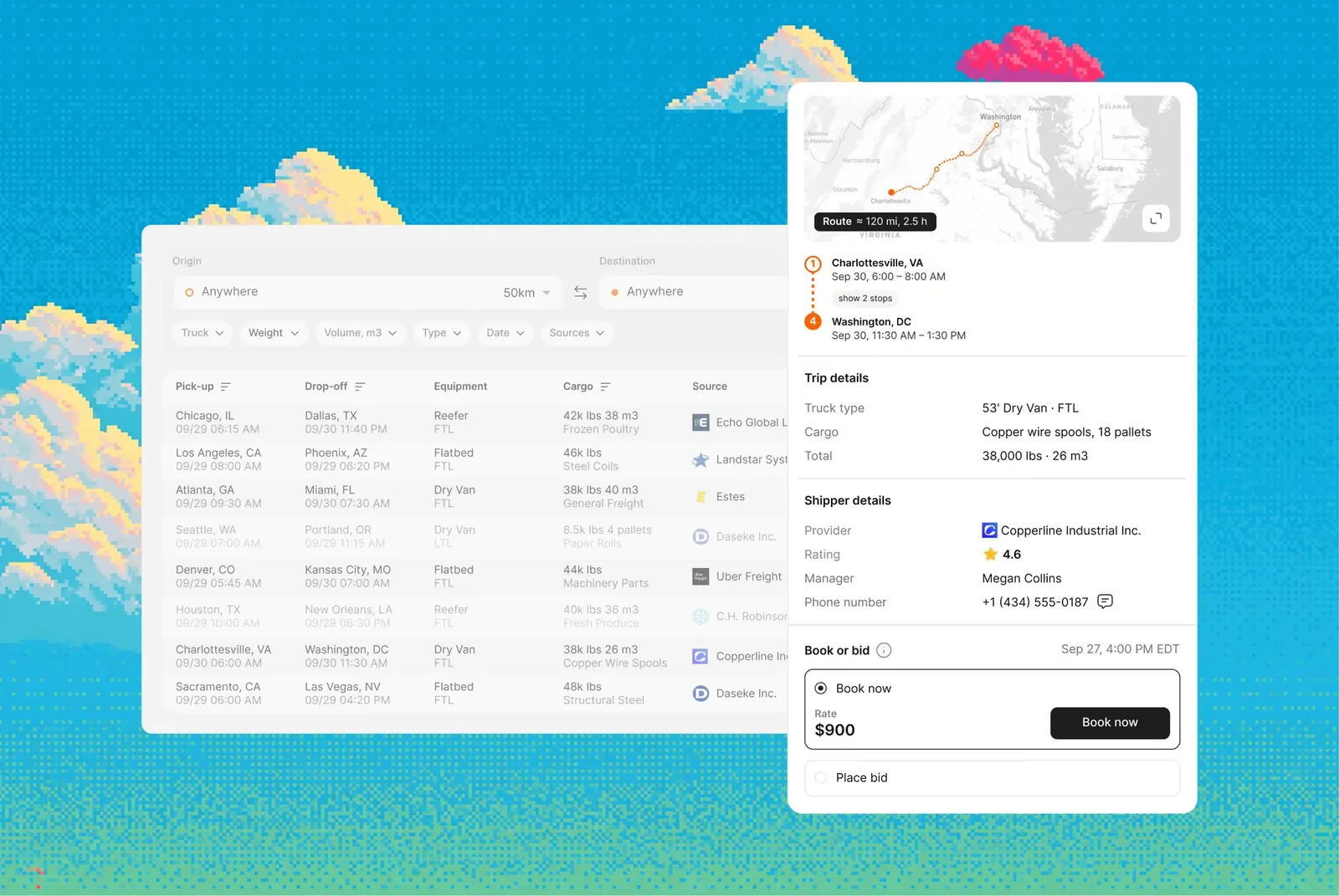
When you pick a load, a Digital Worker then places the bid, writes to or calls the broker, brings the reply back to the load card, and your dispatcher confirms the booking. A dedicated planner shows every truck’s current and next trip across the calendar, so a dispatcher can start a reload search a day before a truck unloads.
For check calls, tracking uses the driver’s Cargofy Go app or the carrier’s telematics, including Samsara and Motive. When neither is available, a Digital Worker calls the driver or messages them on WhatsApp, Viber, or Telegram and records location and ETA on the trip.
Key features:
- Load Hub: one ranked search across email, connected load boards, and Cargofy shippers, with saved lane alerts that run 24/7 and flag loads near each truck’s drop-off
- Digital Workers: bids, broker emails and calls, with every reply logged on the load card and every booking confirmed by the dispatcher
- Planner: each truck’s current and next trip in one neat calendar, load searches per truck, and open trucks published to connected load boards
- Trips: the worker suggests a truck and driver from your fleet and builds the return leg together with the outbound one, for the dispatcher to confirm
- Check calls by phone and messenger: location and ETA written to the trip, with delay alerts while there’s still time to warn the customer
- Architect: ask for a task or a change to the workflow by text or voice, and it hands the task to a Digital Worker or updates your workspace once you confirm
- Activity Log: every bid, call, and booking request is timestamped and attributed to the worker that made it
Hire your first Digital Worker free and have your next load lined up before the truck unloads. Explore Load Hub →
2. Optimal Dynamics: AI Load Planning for Large Truckload Fleets
Optimal Dynamics focuses on building decision software for truckload carriers and private fleets. Its engine plans at three horizons: a month to a year out for network and fleet strategy, 1 to 15 days out for load acceptance and allocation, and under 24 hours for dispatch, reassignment, and exceptions. It uses reinforcement learning to estimate what a driver-to-load decision is worth further down the network, not only on the next load.
They recently launched Scale, a set of agents that source, negotiate, and secure freight through load boards, direct shipper channels, email, and EDI once the engine finds where the network needs more loads.
This is a tool for large asset-based fleets with years of TMS history and a strong planning team to work alongside it. Optimal Dynamics is a certified McLeod partner, the rollout is sales-led, and pricing isn’t public, so a fleet of 10 or 20 trucks will likely find it more than it needs.
Key features:
- Tactical planning: load acceptance, allocation, and future visibility alerts 1 to 15 days out
- Real-time decisions: driver dispatching, reassignment, and exception handling inside a 24-hour window
- Strategic planning: simulations for network, fleet, and metric changes
- Scale agents: freight sourcing and negotiation through load boards, shipper channels, email and EDI
- McLeod integration: planning recommendations brought into the TMS most of your planners already use
3. PCS Software: AI Dispatch Built Into a Carrier TMS
PCS Software is a TMS that primarily targets carriers running 25 to 1,000+ trucks, and since 2025, now comes with Cortex, an AI engine built into the platform itself. Unlike standalone AI dispatching software, Cortex has no separate product or login, so the AI works inside the same screens many dispatchers already use for loads, accounting, and fleet maintenance.
Of the three dispatch modules in Cortex, Dispatch Manager recommends or makes driver assignments, while the Load Opportunity Manager pulls freight leads from emails, documents, and EDI, and then ranking them by margin and operational fit. Finally, the Backhaul Booster finds return freight by combining 12 months of your own lane history with live load board listings.
The trade-off is that the AI comes with the TMS, so a carrier that’s happy with its current stack would have to migrate to get Cortex, and pricing is quoted after a demo.
Key features:
- Dispatch Manager: driver-to-load recommendations based on 36+ data points
- Load Opportunity Manager: freight leads from email, documents, and EDI, ranked by rate, margin, and fit
- Backhaul Booster: return loads found from your lane history and live board listings
- Margin visibility: margin by load, lane, and driver in real time
- Full carrier TMS: dispatch, accounting, driver pay, maintenance, and compliance alerts in one system
4. Alvys: AI-Native TMS With Built-In Freight Agents
Alvys is a cloud TMS for carriers and brokers, with an intelligent dispatch planner that recommends a driver for each load, and a maintenance sync with Fleetrock that keeps dispatchers from assigning loads to trucks that are in the shop.
In 2026, Alvys opened Foundry, a layer of AI agents built into the TMS, that accommodates fleets of all sizes. Customers can start from 20+ templates, ask Alvys engineers for a custom agent, or build their own from scratch. The first use cases cover check-call automation, invoice and settlement prep, and track-and-trace exceptions, along with a control layer called Agent Shield that logs every agent action and sends high-impact decisions to a person for sign-off.
As with PCS, the AI comes with the TMS, so Alvys suits carriers that are ready to fully move dispatch, accounting, and settlements onto one new system. Pricing isn’t published, but Alvys does advertise unlimited users and no long-term contracts.
Key features:
- Dispatch planner: driver recommendations for each load, with maintenance sync to keep trucks in the shop off the board
- Foundry AI agents: 20+ templates for tasks like check calls, settlement prep, and track-and-trace exceptions
- Agent Shield: a log of every agent action, with high-impact decisions routed to people
- Accounting and settlements: invoicing, IFTA reporting, and driver, agent, and carrier settlements
- Integrations: 120+ ready-made integrations and native EDI
5. Numeo: AI Load Search and Negotiation for Dispatch Teams
Numeo builds AI dispatch tools that work inside the load boards most dispatchers already use in their day-to-day. Its neat Chrome extension, Numeo Spot, adds a toolbar to DAT and Truckstop that re-ranks loads by profit, shows each broker's factoring and credit status, and emails the broker in one click.
Numeo can also search 15+ boards and broker portals, including RXO, C.H. Robinson, and TQL, in one profit-ranked list. On top of that, AI Hub finds loads from a plain-English request, negotiates with brokers by email using live market rates, and prepares the booking for the dispatcher's approval.
Teams that are also looking for a central system of record can add Numeo One, its AI-native TMS. Keep in mind that Numeo’s load tools run through your own board logins, so the DAT or Truckstop subscriptions stay on your bill.
Key features:
- Numeo Spot: profit ranking, broker factoring and credit checks, as well as one-click broker emails inside DAT and Truckstop
- Multi-board Search: 15+ load boards and broker portals in one profit-ranked search
- Load Radar: alerts when new loads match a saved DAT search (Pro and Ultra plans)
- AI Hub: load search from plain-English requests, email negotiation, and bookings prepared for your approval
- Numeo One: a TMS for dispatch, accounting, fleet, and safety that can replace your current system
6. TruckSmarter Dispatch: Free AI Load Search for Owner-Operators
TruckSmarter Dispatch is a chat assistant inside the TruckSmarter app, built for owner-operators and small carriers. You type what you need in plain language, and it searches TruckSmarter’s load board and your connected Gmail to compare rates, estimate take-home pay, and check fuel prices. It can also place bids, draft broker emails, call brokers to confirm load details, and schedule follow-ups for later in the day.
You stay in charge of every booking, since Dispatch books directly only with a select few brokers where you’ve connected your credentials, and for phone bookings, it transfers you in at the end so you confirm the load yourself.
It’s one of the easiest ways on this list to try AI dispatch software free, since the free plan comes with a limited weekly allowance of requests, while Dispatch Unlimited costs $49 a month with no commission per load. The load pool is limited to TruckSmarter’s board and your inbox, though, so carriers who rely on other boards or contract freight will still have to search those elsewhere.
Key features:
- Plain-language load search: loads, rates, market conditions, and estimated take-home pay from one chat
- Broker outreach: bids, drafted emails, and calls to verify load details
- Gmail connection: broker load emails brought into the same search
- Scheduled follow-ups: several steps chained into one request and run later in the day
AI Dispatch vs Automated Dispatch Software
There’s a subtle difference worth knowing between AI dispatch and simply automated dispatch, and for the most part, it comes down to how each one handles messy input. Automated dispatch software follows the rules you set, such as assigning the nearest available truck, offering a load to the first driver with enough hours, or posting open capacity at 6 a.m. daily. That works quite well when every load arrives as a clean record in your system.
In trucking, that’s rarely the case, however, because loads arrive as broker emails, PDF rate cons, screenshots, and voicemails, and the right truck depends on tomorrow’s drop-off as much as today’s location.
AI-powered dispatch software reads that unstructured input, pulls out the important data like origin, dates, equipment, and rate, and scores the options against your history and limits. Some tools go a step further and work as an AI agent for dispatch automation, calling, emailing, or messaging the other side based on what they found.
Most products now blend both approaches, with custom rules setting the boundaries (rate floors, approved brokers, who has to sign off) and the AI working alongside them. If most of your freight comes in by email and phone, simply having an automated dispatch system built on rules alone will still leave your dispatchers doing a lot of the heavy lifting.
Where To Start With AI Dispatch Software
The best AI dispatch software is the one that takes the biggest chunk of manual work off your dispatchers, and that share is different for every fleet. Small carriers working load boards get the fastest return from simple load search assistants, while larger fleets choose between AI that works alongside their TMS, like Cargofy, and AI that comes with a new one, like PCS or Alvys.
Before buying, spend some time noting where your dispatchers’ hours actually go, and then pilot the tools that focus on that specific job on a few trucks or one lane. Make sure to set the right approval rules up front so the AI knows what it can do on its own and what waits for a dispatcher. After a few weeks or so, compare the loads booked and hours spent, and roll it out further only once the numbers hold up.