

Carrier Scorecards: What to Measure Before You Award a Lane


When you run a freight RFP, you collect carrier bids and award a lane to the lowest one, say $2,000 a load. Now imagine that, six months later, spot rates on that lane climb to $2,300.
The problem is that, while your contract still says $2,000, nothing forces the carrier to accept your loads at that price, so it starts rejecting them to haul better-paying freight. Each rejected load then goes to a backup carrier or the spot market, which ends up costing about 18.2% more than the contract rate in a tight market, according to MIT research.
And just like that, that tender rejection cost is how the cheapest bid becomes an expensive lane.
A carrier scorecard grades every carrier on the same weighted metrics, like on-time delivery, tender acceptance, and claims, using real shipment data. Here's how to score carriers before awarding a lane, so it goes to proven performers instead of simply the lowest bid.
Start With the Carrier Vetting Process
Compliance is pass/fail, and it should always come as the first step of your carrier vetting process. A carrier with lapsed authority or an “Unsatisfactory” safety rating shouldn’t be considered, no matter what its on-time record says.
Check four key criteria:
- active operating authority
- insurance confirmed with the issuer
- FMCSA safety rating (Satisfactory, Conditional, Unsatisfactory, or Unrated)
- inspection, violation, and crash history in FMCSA's Safety Measurement System
Keep in mind that there's no single FMCSA safety score to look up, because the 2015 FAST Act took BASIC percentiles for property carriers off public view, so read the raw data yourself.
The stakes went up in May 2026, when the Supreme Court ruled 9-0 in Montgomery v. Caribe Transport II that federal law doesn't shield brokers and 3PLs from negligent-hiring claims over unsafe carriers. This makes a written vetting policy, applied to every load, part of the job.
The Carrier Performance Metrics That Carry Weight
A carrier scorecard rolls a handful of carrier performance metrics into one number, and these five cover the main ways a carrier costs you money: late freight, rejected tenders, failed appointments, damaged cargo, and billing errors.
Each one is a simple ratio you calculate per carrier for every review period, using system records like your TMS tender log, tracking timestamps, and dock check-ins, not the carrier's own status updates.
Also, remember that carriers are more likely to take your loads when your rate is close to the current market, you tender volume consistently, and their trucks don't sit for hours at your docks. So if your tender acceptance rate drops across all carriers at once, check your own side first.
A Carrier Scorecard Weighting Model You Can Use
Turn each metric into a 0-100 score against your target, then multiply each score by its weight and add them up, while compliance stays outside the math as a pass/fail gate.
Two rules to keep the numbers honest:
- only rank carriers with at least 10 to 15 loads in the review period (because a score built on three loads is noise)
- adjust the weights to fit your freight, for instance, giving the claims ratio more weight if you ship expensive or fragile goods, and the OTD rate more weight if customers fine you for late deliveries
Carrier Scorecard vs Rate Alone: A Worked Example
As previously mentioned, the cheaper bids can end up costing more once rejections are priced in, so let’s see how that works with some numbers. Take one lane with 400 loads a year:
- Carrier A bids $2,000 per load, with a 75% tender acceptance rate and a 6% first-attempt failure rate.
- Carrier B bids $2,050 per load, with 95% acceptance and a 2% first-attempt failure rate.
- Every rejected load goes to backup capacity at 18.2% over that carrier's contract rate (MIT's tight-market figure).
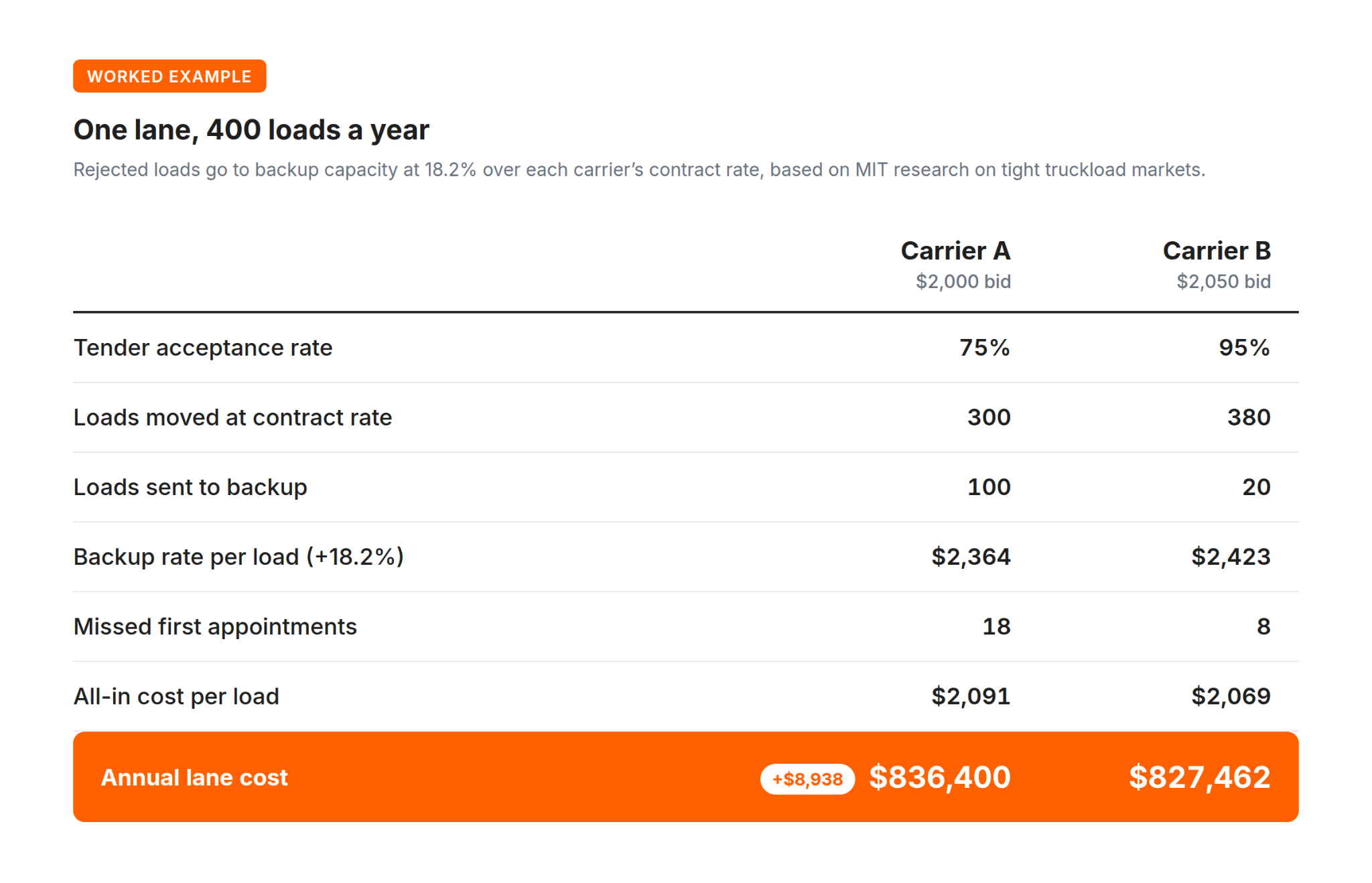
As a result, the "cheaper" bid costs $8,938 more per year, about $22 per load, and that's before counting missed pickup and delivery appointments (roughly 18 for Carrier A vs 8 for Carrier B).
In other words, the rate is just one line on the invoice, whereas the scorecard shows the whole cost.
How Often to Review Carrier Scorecards
Run the scorecard on four cycles:
- Weekly: exceptions such as rejections, missed appointments, and compliance changes
- Monthly: a scorecard shared with each carrier
- Quarterly: a business review where volume moves to the best performers
- Annually: the RFP, scored on trailing 12-month data
When a carrier misses the target for a full review period, open a corrective action plan for underperforming carriers with a written root cause, a specific fix, one owner on each side, and a defined window to improve.
Finally, sort carriers into tiers, like preferred, approved, probationary, and inactive, and allocate more loads to the top performers. Otherwise, the scorecard is just another report.
AI Agents for Carrier Management: What Gets Automated and What Stays Human
Running a scorecard across 50 carriers and 300 lanes every week is no easy task, especially since the inputs are scattered across email threads, carrier portals, phone calls, the TMS, and the freight audit files. That's also the reason why so many scorecards go stale over time.
Agentic AI in logistics is slowly taking over this work, though adoption is early, with only roughly one in ten providers having embedded AI into their core operations at scale. At the same time, shippers have already started weighing providers’ AI capabilities when choosing partners.
Early adoption therefore also means a real edge for teams that move first, because AI agents for carrier management already run most of the procurement loop around the scorecard.
Zammler Kazakhstan, for example, runs its freight procurement with Cargofy this way, scoring 130+ carriers on reliability and cost across 10,000+ tenders a month.
They send tenders, chase bids by phone, email, and messaging apps, track loads, and check documents and invoices, logging every result so your scores stay current and problems get flagged early. All of that frees your team to focus on the tasks and decisions that still need human judgment:
On a live lane, it looks something like this:
A carrier's on-time delivery (OTD) rate slips below target midweek. By then, the agent has logged each late arrival from tracking data, recalculated the score, emailed the carrier's dispatcher for a root cause, and lined up the backup carrier in case you move the lane. Your team now has all the information and just needs to make one decision — keep the carrier on the lane or not.
Brokers and 3PLs get the same split at a much larger scale, which is why an AI digital workforce for freight brokers saves them even more manual work.
Cargofy's AI Agents for Freight Procurement and Carrier Scorecarding
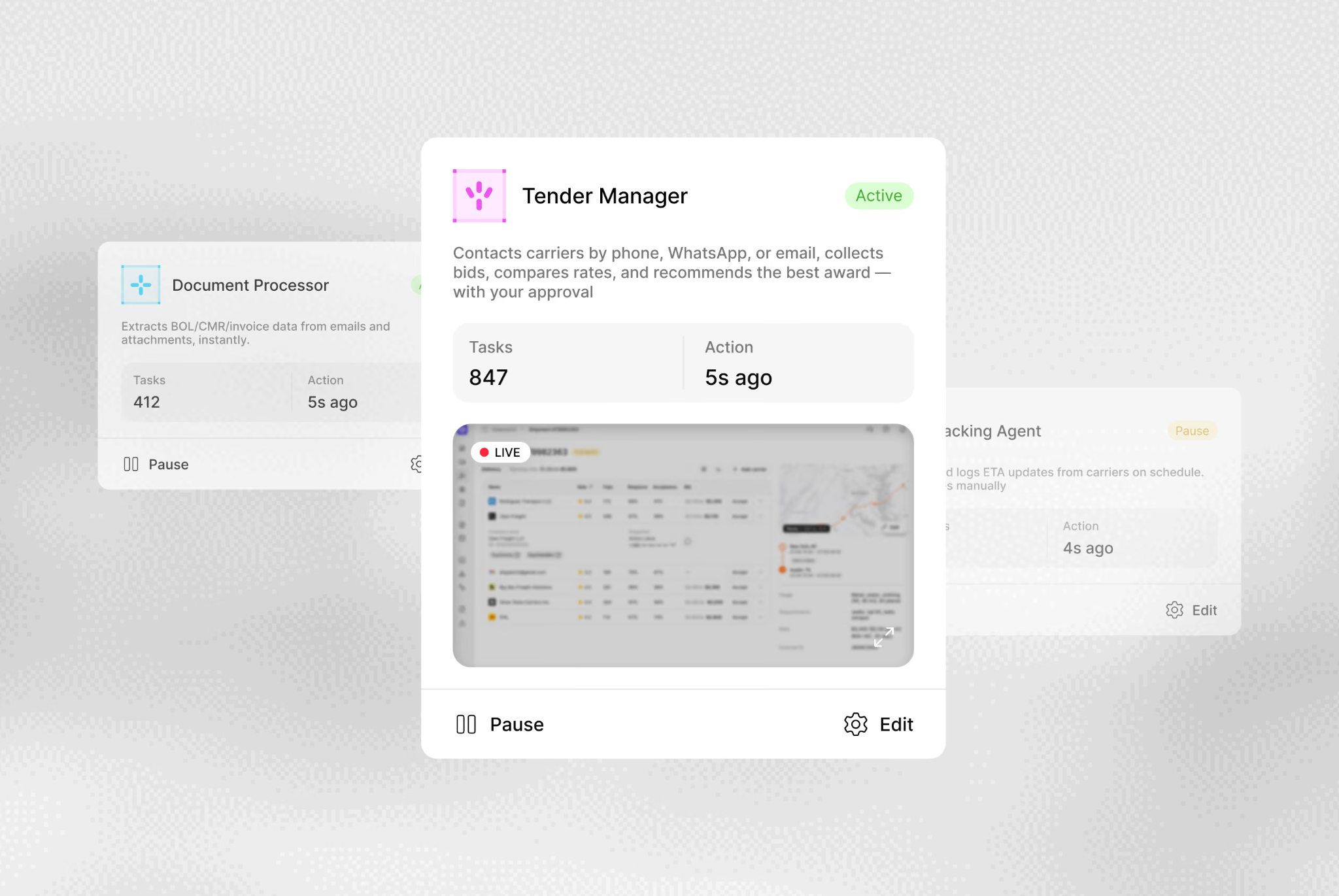
Cargofy's AI workers take over automated carrier scorecarding by collecting the scorecard data, calculating carrier scores as loads close, and triggering corrective actions when a carrier slips. Beyond the scorecard, the same digital workers also handle tendering, dispatch, tracking, documents, and billing support, from initial quote to delivery.
They work across email, portals, phone calls, and TMS platforms, while connecting to more than 90 tools (including ERP, load boards, and carrier compliance systems) and running 24/7 in 28 languages.
You still choose which decisions and processes you’d prefer to stay with your team. And if your carrier and rate data can't leave your systems, Cargofy's open-source ATLAS server keeps it inside your own infrastructure.
Set Your Lane Award Criteria Before the Next Bid
A carrier scorecard shows you which carriers accept, deliver, and bill correctly, so you can price in that reliability before the award instead of paying for it after.
The easiest place to start is your next RFP — run every carrier through the vetting gate, score your current carriers on the last 12 months of data, and publish the scorecard as part of your lane award criteria in the bid package. When carriers know performance decides who wins, the best ones compete harder for your freight.
If you want every carrier scored after every load without adding headcount, book a demo and see how our digital workers can run your tenders, scorecards, and carrier follow-up.