

What Is Backhaul Trucking? How To Find Backhaul Loads


Many carriers put most of their planning work into the outbound load, settling the rate and the appointment early on. The trip home often gets sorted out later, usually from the receiver’s dock once the trailer is already empty. That habit is expensive, because the return leg costs almost as much to drive empty as it does loaded.
In fact, truckload margins are thin enough that one empty return leg can wipe out most of what the outbound load earned. This guide covers how backhauls work, why they pay less than the outbound load, when a cheap one is still worth taking, and how to find backhaul loads before the truck unloads.
What Is a Backhaul in Trucking?
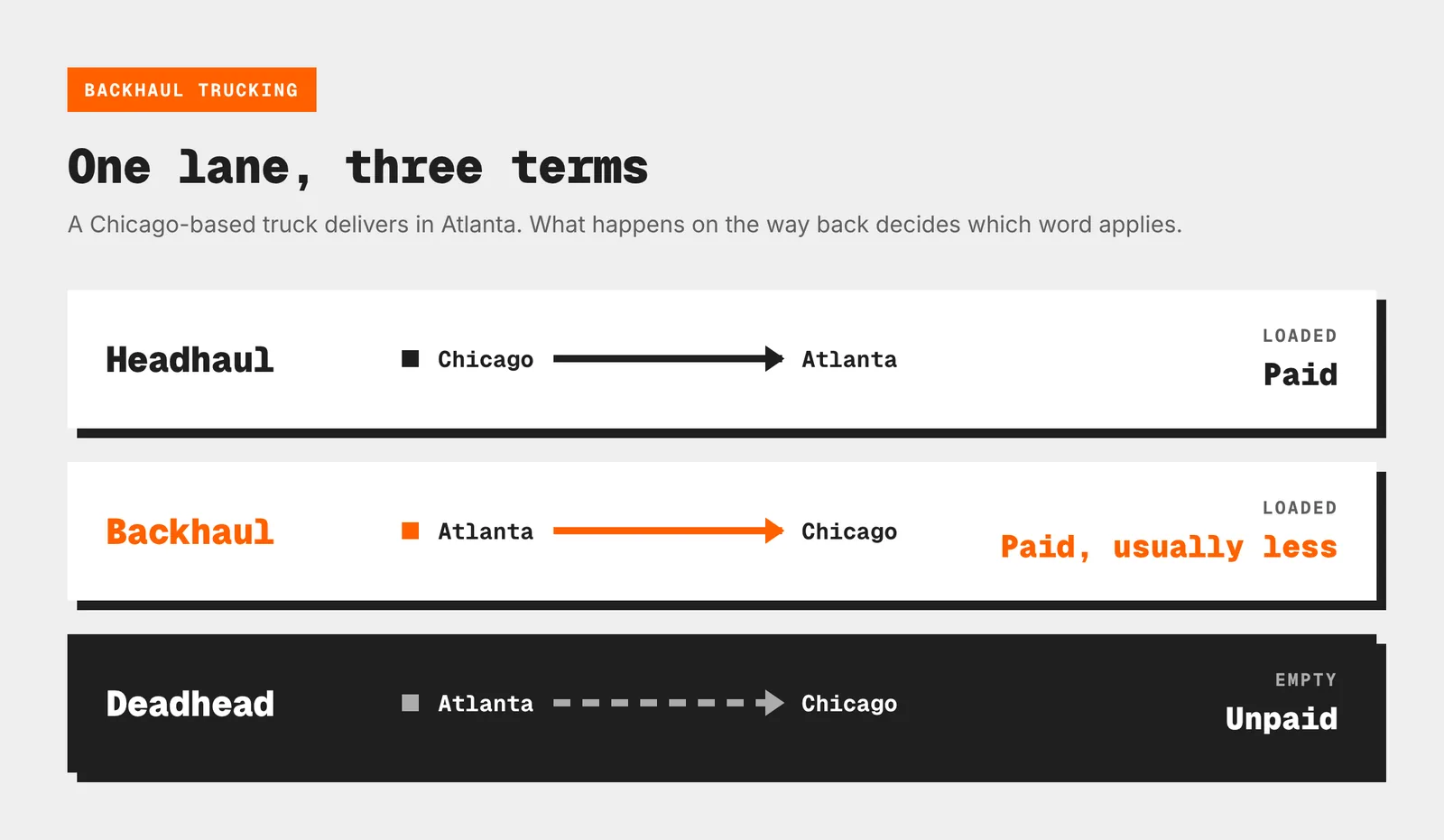
A backhaul in trucking is a paid load that a truck carries back toward where it started, after making a delivery. In simple terms, if a Chicago-based truck hauls freight to Atlanta, the load it picks up in Atlanta heading back to Chicago is the backhaul. In fact, any paid freight on that return leg counts as a backhaul load, whether it goes all the way home or most of the way.
Two terms worth keeping in mind to avoid any confusion down the line:
- Backhaul vs headhaul: the outbound leg is the headhaul, and it usually pays better, which is why the split shapes how lanes get priced.
- Backhaul vs deadhead: a backhaul carries a paid load on the return leg, while deadhead means driving that leg with an empty trailer, and those deadhead miles are a big hidden cost.
In practice, the backhaul meaning in trucking applies mostly to trucks that need to get home, like regional fleets, private fleets, and owner-operators who want regular home time. A one-way OTR truck doesn’t run a return trip at all, so for its dispatcher, every load is simply the next one from wherever it delivers.
Types of Backhauls: Internal and External
There are two types of backhauls, and the difference comes down to whose freight rides home:
- An internal backhaul carries the company’s own freight on the return leg. It’s the most common form of backhaul logistics in private fleets, which pick up from suppliers on the way back from store deliveries or bring back returns and empty pallets.
- An external backhaul is a load from another company, booked through a broker, a load board, or directly with a shipper. Most for-hire carriers and owner-operators refer to this type when they talk about backhauls, and it’s also where the rate gets negotiated.
Why Backhaul Trucking Rates Run Lower
Backhaul trucking rates are lower because freight doesn’t move evenly. Some markets take in far more loads than they ship out, so trucks pile up there after delivering and compete for the few outbound loads, which pushes rates down. Carriers price that in when they quote the headhaul, so the rate into a market and the rate out of it can be far apart on the same lane.
Florida is a classic example here, since the state takes in much more freight than it ships for most of the year. That’s why freight into Florida pays well, but the trucks leaving it will often settle for backhaul rates that just about get them north.
You can always check a certain market before you book a load into it. The FreightWaves Headhaul Index subtracts inbound tender volume from outbound tender volume, so a negative reading will show you that more freight is coming into the market than leaving it.
As for backhaul costs, the truck pays most of them whether the trailer is full or empty, while shippers in a backhaul market get cheaper capacity from carriers heading home.
Is a Cheap Backhaul Worth It? The Round-Trip Math
A cheap backhaul is worth it in most cases, because if the truck has to come back anyway, the load only needs to beat the alternative, which in this case is just driving home empty. That’s why comparing it with your full cost per mile is the wrong test.
Most of the cost of the return leg doesn’t depend on what’s in the trailer. ATRI’s report puts the average cost of running a truck in 2025 at $2.336 a mile, of which $1.854 is non-fuel: driver pay, truck payments, insurance, repairs, and tires. Those costs show up on the return trip either way.
To put these numbers into perspective, here’s a round trip from Chicago to Atlanta, about 715 miles each way, with example rates of $3.00 a mile outbound and $2.00 a mile for the backhaul:
| Deadhead home | Backhaul at $2.00 a mile | |
|---|---|---|
| Miles driven | 1,430 | 1,430 |
| Revenue | $2,145 | $3,575 |
| Cost at $2.336 a mile | $3,340 | $3,340 |
| Round-trip result | -$1,195 | +$235 |
| Revenue per mile driven | $1.50 | $2.50 |
On its own, the $2.00 backhaul pays less than the $2.336 a mile it costs to run the truck, and anyone checking it against their cost per mile would pass on it. But the truck spends that money driving home either way, so the backhaul’s $1,430 goes almost straight to the bottom line and turns a $1,195 round-trip loss into a $235 profit.
A cheap backhaul is still the wrong call when it:
- blocks a better headhaul the next morning
- needs a long deadhead to the pickup
- uses up the driver’s remaining hours of service
- comes from a broker with a slow payment record
- delivers into another weak market
All five of these calls are much easier to make before the truck is sitting empty at the receiver’s dock. A dispatcher who knows today which trucks unload where tomorrow can still weigh a cheap backhaul against a better headhaul or a short repositioning leg. That kind of visibility across the whole fleet is what Cargofy’s Planner is built for.
Where To Find Backhaul Loads (and When To Start Looking)
The best backhaul gets lined up before the truck even heads out, while the worst ones get booked from the receiver’s dock after unloading, when the good freight nearby is already gone. These seven steps move the search earlier and also widen where you look:
- Check the return before you book the outbound: Look at outbound volume and rates in the destination market first. A strong headhaul into a market with little freight going out needs a rate high enough to cover the way back.
- Start searching 24 to 48 hours before delivery: Search by radius around the drop-off point, and set lane alerts for the return direction so that any new backhaul loads will reach you as soon as they’re posted.
- Ask the outbound broker or shipper for a reload: Many have freight going the other way and would rather give it to a carrier they already trust. Quote it like any other load, though, and don’t call it your backhaul, since brokers know a truck heading home will usually take less.
- Work the receivers and shippers in the destination market: The customer you deliver to, or its suppliers, often ships toward your home area. A few of those contacts can turn into a regular return lane, where the freight that gets backhauled each week is known before the truck leaves.
- Partner with private fleets and other carriers: Private fleets with spare return capacity, and carriers running the opposite lane, can trade or share freight so neither truck comes home empty.
- Plan a triangle when the direct return is weak: A short repositioning leg into a stronger market often pays better than a long, cheap backhaul straight home.
- Check fit before you accept: Confirm the equipment matches (a food-grade trailer can’t take just any load, and a reefer needs the right temperature setting), the driver has enough hours left after unloading, the pickup window works with the delivery, and the broker pays on time.
How Cargofy Planner and Load Hub Line Up the Return Load
Most of the seven steps covered above come down to seeing which trucks will be empty tomorrow and where, which is exactly what Cargofy’s Planner and Load Hub are built for.
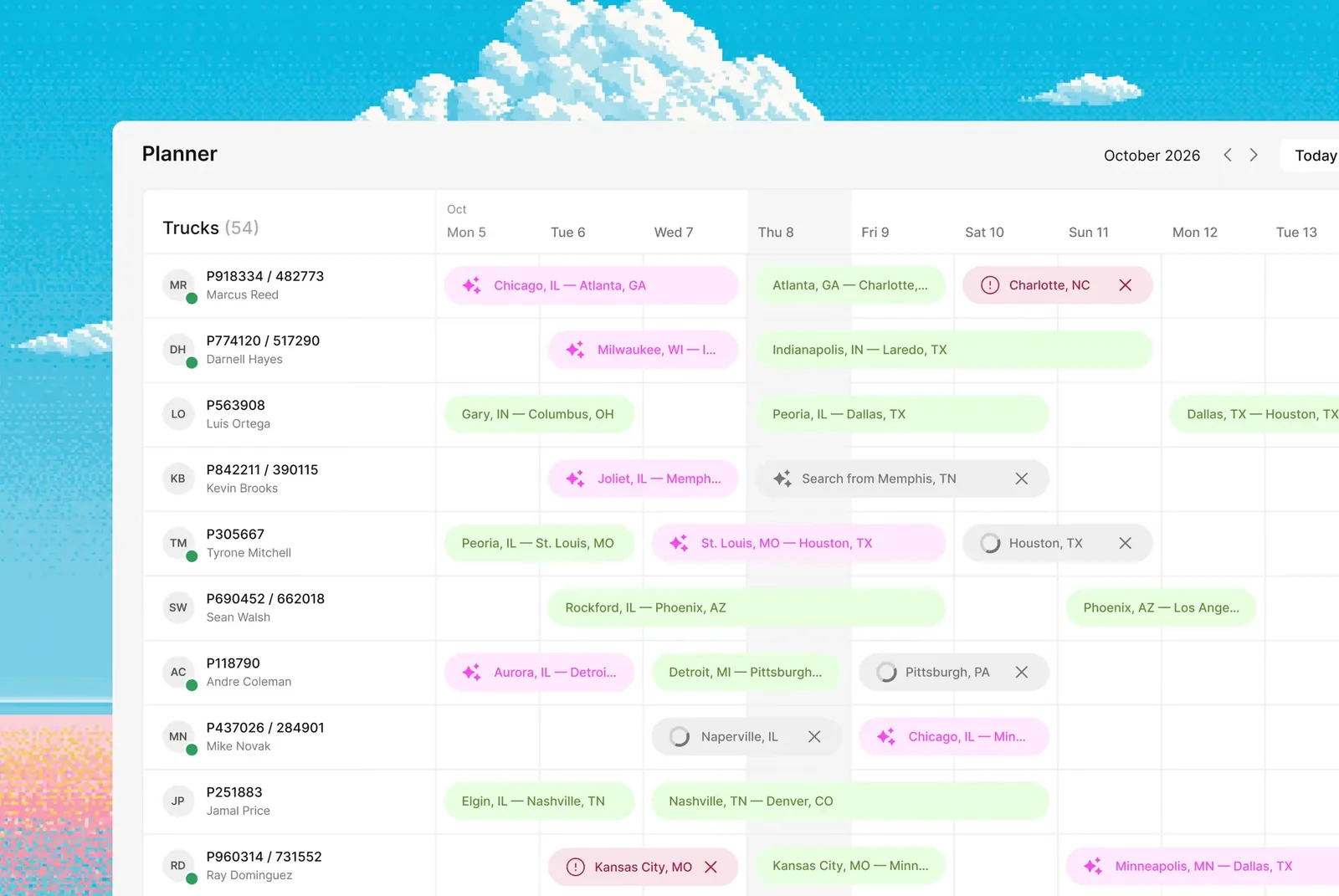
Planner lays out every truck’s schedule in one neat calendar, with each trip, load search, idle day, and repair on the date it happens. So if one of your trucks is due to unload in Orlando tomorrow, the dispatcher can see it today and set up a backhaul search from Orlando for that truck.
The search opens in Load Hub with the loads that fit, so the truck’s backhaul gets lined up before it unloads. With every truck planned 48 hours ahead like this, Planner users run 15% fewer empty miles on average.
Load Hub pulls loads from your email, your connected load boards, and shippers on the Cargofy platform into one table, so the dispatcher runs one central search instead of checking separate board tabs and inboxes. Saved lane alerts flag loads near the drop-off and keep running 24/7.
When a load that fits is found, an AI Digital Worker sends the bid or booking request, and the dispatcher gives the final confirmation. Owner-operators, who pay for every empty mile home out of their own pocket, can get started with Cargofy on the free one-truck plan.
Set up the backhaul search before your next truck unloads. Explore Planner → or Explore Load Hub →
Plan the Return Before You Book the Outbound
Most answers to what is backhaul trucking stop at the definition, but the decision a carrier faces on every return leg is a simple comparison. A backhaul only has to leave you better off than driving home empty, even when it pays well below the headhaul. To get started, pick the two or three lanes you run most, check how much freight leaves each destination market, set lane alerts for the way back, and start every return search a day or two before the truck delivers.