

What Is FTL Shipping? How Full Truckload Shipping Works and How Shippers Book It

Once a shipment fills most of a trailer, LTL usually stops making sense. Freight class charges and terminal transfers drive up the price, and each cross-dock adds more transit time and increases the risk of damage. So you end up booking a whole truck instead.
That’s where full truckload shipping gets harder than it looks, because you still need a carrier who takes the load at the agreed rate and doesn’t pad the invoice with any surprise charges. Below we’ll cover how FTL works, how much fits in a standard trailer, when it beats LTL, what it costs right now, and how shippers book it step by step.
How FTL Trucking Works
With FTL shipping, a single shipper books the entire trailer instead of sharing it with other shippers’ freight. The truck loads at your dock, drives straight to the consignee, and delivers without stopping at terminals or moving your freight to another trailer.
This of course means that you pay for the whole truck, not simply for the pallets or the floor space your freight takes up. In more practical terms, FTL freight is any shipment that fills or nearly fills a 53-foot trailer, or dense freight that hits the weight limit before the trailer is even full.
A typical FTL trucking run has four stages:
- Pickup: the driver waits while your team loads (live load) or hooks up a trailer you loaded in advance (drop trailer).
- Transit: the truck runs direct, within FMCSA hours of service. A solo driver can drive 11 hours inside a 14-hour on-duty window after 10 hours off, with a 30-minute break after 8 hours of driving. Team drivers take turns, so these trucks will keep moving on long, time-critical lanes.
- Delivery: the carrier unloads at the scheduled appointment.
- Proof of delivery: the consignee signs the POD, which the carrier needs to invoice.
Most FTL freight moves in 53-foot dry vans, while reefers handle temperature-controlled loads, and flatbeds and step decks carry machinery, steel coils, lumber, and other freight that loads from the side or top.
How Many Pallets and Pounds Fit in a Full Truck Load?
A standard 53-foot dry van holds 26 standard 48x40 pallets single-stacked, or 52 if your product can be double-stacked, and roughly 42,000 to 45,000 lb of cargo.
The limit comes from the federal cap of 80,000 lb gross vehicle weight on the Interstate, which also covers everything beyond your cargo, including the tractor, the trailer, and fuel. Canned beverages and paper rolls can reach that limit with much of the floor still empty, while light, bulky goods fill all 26 pallet spots long before they get close to full weight capacity.
| 53-foot dry van | Typical capacity |
|---|---|
| Interior dimensions | About 52’6" long, 100" wide, and 9’ high |
| Pallets (48x40) | 26 single-stacked, 52 double-stacked |
| Volume | About 3,800 to 4,000 cubic feet |
| Cargo weight | About 42,000 to 45,000 lb |
| Federal gross weight limit | 80,000 lb for the truck, trailer, and cargo combined |
That’s also the reason why many carriers will answer what is FTL freight in both pallets and pounds, since a load qualifies as soon as it hits either limit.
Are Full Truck Loads Cheaper Than LTL?
Per pallet, yes, but only once the shipment is big enough. LTL is usually the cheaper option up to about 6 pallets, but when it comes closer to 10 pallets, or 10,000 to 15,000 lb, a full truck load will usually cost less per pallet, even though the total bill is higher.
For shipments in that middle range, volume LTL or partial truckload (a shared trailer that skips LTL terminals) often gets the best price point. These are typical ranges, and the exact crossover very much depends on the lane and the market.
Cost isn’t the only reason to choose full truckload shipping, though. A full truck is also usually the better choice for time-sensitive freight, since nothing waits on a cross-dock, and for fragile or high-value goods that get loaded once and unloaded once.
Here’s the short version of FTL vs LTL:
| FTL | LTL | |
|---|---|---|
| Pricing | Per truck, usually quoted per mile | By weight, dimensions, and freight class |
| Trailer | Used by one shipper | Shared with other shippers |
| Handling | Loaded once, unloaded once | Moved through terminals and cross-docks |
| Transit | Direct from pickup to delivery | Slower, with terminal stops |
| Best for | About 10+ pallets or 10,000+ lb, urgent or fragile freight | 1 to 6 pallets, flexible delivery dates |
How Much Does FTL Cost?
FTL is priced per truck, which usually includes the per-mile linehaul rate plus a fuel surcharge and any accessorial charges.
In real money, van spot rates reached $3.49 a mile in early November 2026, as per FreightWaves SONAR data, so a 500-mile dry van load would run about $1,745 before accessorials.
Full truckload rates are also affected by other factors worth keeping in mind:
- Distance and lane: freight leaving a busy market costs more, while a load on a truck’s way home often comes cheaper.
- Equipment: reefers and flatbeds cost more than dry vans.
- Lead time: last-minute loads pay a premium.
- Season and capacity: produce season and the holiday retail peak push rates up, and so does any week when there’s more freight than available trucks.
Then come accessorials, which are the charges for anything outside a standard pickup and delivery, such as detention, layover, truck order not used (TONU), lumper fees, extra stops, and driver assist. Make sure to agree on them before booking, because they’re the main reason the final full truckload shipping cost may end up above the initial quote.
Another lever is competition, since a load that two carriers quote has far less price pressure than one that ten carriers bid on. Cargofy’s Freight Procurement builds that competition for you, sending the load to your contracted carriers, then the Cargofy network and load boards, so the winning rate comes from a real bidding round.
How Shippers Book FTL Freight
Booking FTL comes down to finding a carrier for each load at a rate you know in advance. Most shippers mix three routes: contract carriers they award lanes to in an annual bid, brokers and 3PLs who find capacity for them, and spot quotes for everything else. Whichever mix you use, arranging full truckload freight shipping usually follows the same seven steps.
- Get the load details right: Carriers price what you tell them, so send the origin and destination, pickup and delivery windows, weight, pallet count, commodity, equipment (with the reefer temperature, if needed), and live load or drop trailer. Any missing detail, like an appointment the driver didn’t know about in advance, usually comes back as an accessorial.
- Choose contract or spot: Lanes you ship every week belong on a contract rate with a primary carrier. One-off and seasonal loads can go to spot quotes, where the price follows the market on the day of the shipment.
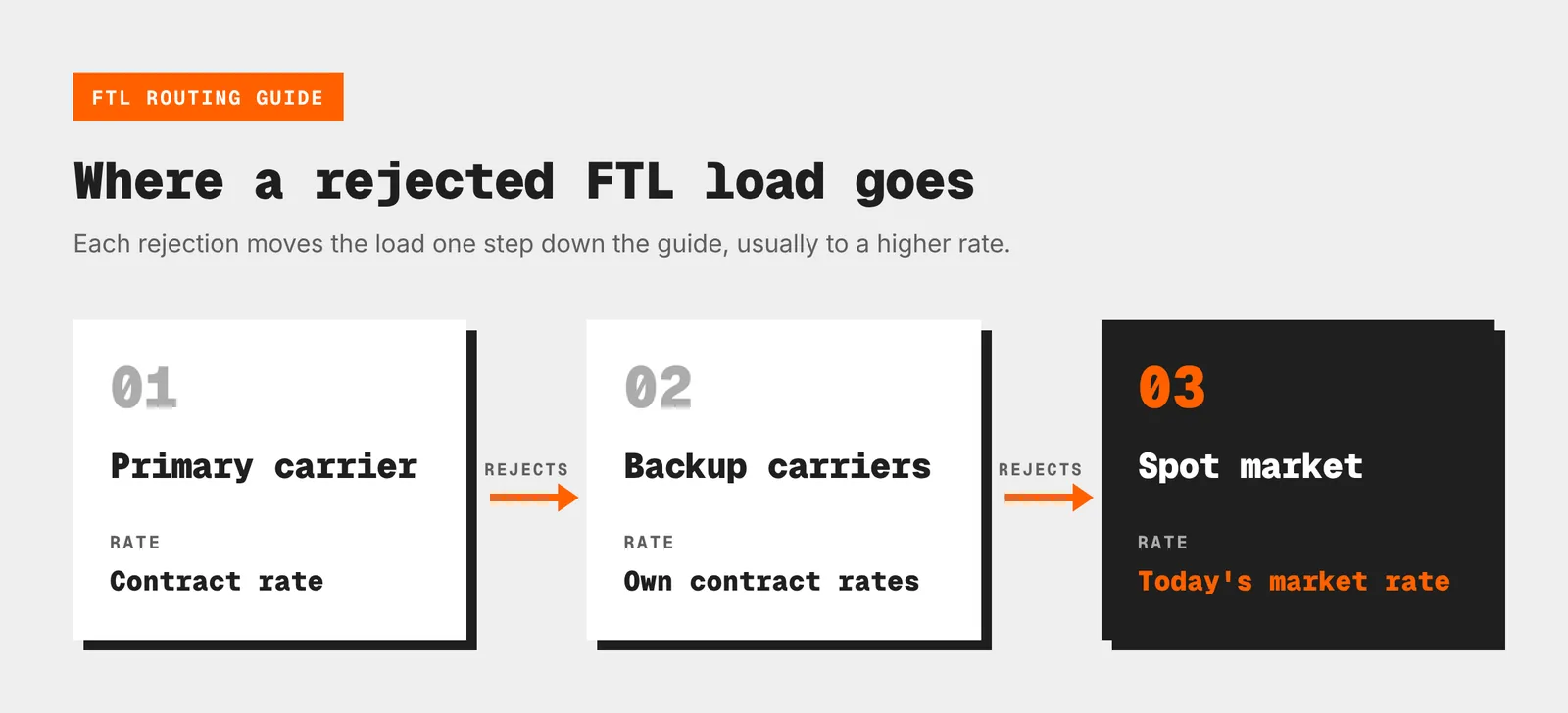
- Tender to your routing guide first: The primary carrier on the lane accepts or rejects the load, then it moves to your backup carriers, and only then to the spot market. Rejections have become quite common right now, with SONAR’s Outbound Tender Rejection Index at 12.95% as of November 2026. This means carriers are turning down about 1 in 8 contract loads, and each rejection usually pushes the load to a higher rate further down the guide.
- Compare the all-in price: Look at the linehaul, fuel, and accessorial terms together, then check the carrier’s fit for the lane and equipment. The cheapest linehaul on paper may very well end up exceeding other quotes once detention terms and fuel are added.
- Check the carrier before you award: Confirm active FMCSA operating authority, a current insurance certificate, and the carrier’s safety record. A carrier packet turns these checks into a standard part of onboarding.
- Book with enough lead time: MIT research on C.H. Robinson’s TMC shipment data found that loads tendered with less than 2 days’ notice cost about $41.60 more per load than loads tendered 2 to 5 days out. This data is somewhat outdated as it covers 2015 to 2018, so treat the number purely as directional.
- Confirm in writing and track to delivery: Get a rate confirmation or load tender that states the rate, the accessorial terms, and the free time for detention. Then issue the bill of lading (BOL) at pickup, follow the tracking updates, collect the POD, and check the invoice against what you initially agreed on.
How Cargofy Helps Shippers Cover Every FTL Load
Cargofy’s digital workers take over the carrier sourcing that slows down most FTL bookings, sending each tender and chasing the bids by phone, email, and messenger. With Freight Procurement, you post the load once, and the tender works outward from there, starting with your contracted carriers before widening to the Cargofy network and the load boards you already use.
Carriers bid from their Cargofy account, by email, in messengers, or on a call with your Digital Worker, and every bid lands in one neat list. A target rate blocks higher bids, a bid step keeps prices moving, and a late bid extends the tender. If no bids arrive 5 minutes before close, your Digital Worker starts calling carriers, while your team still picks the winner.
Retailer Avrora Multimarket, for example, ran 75,000+ tenders through Cargofy in a year and ended up saving over USD 7M.
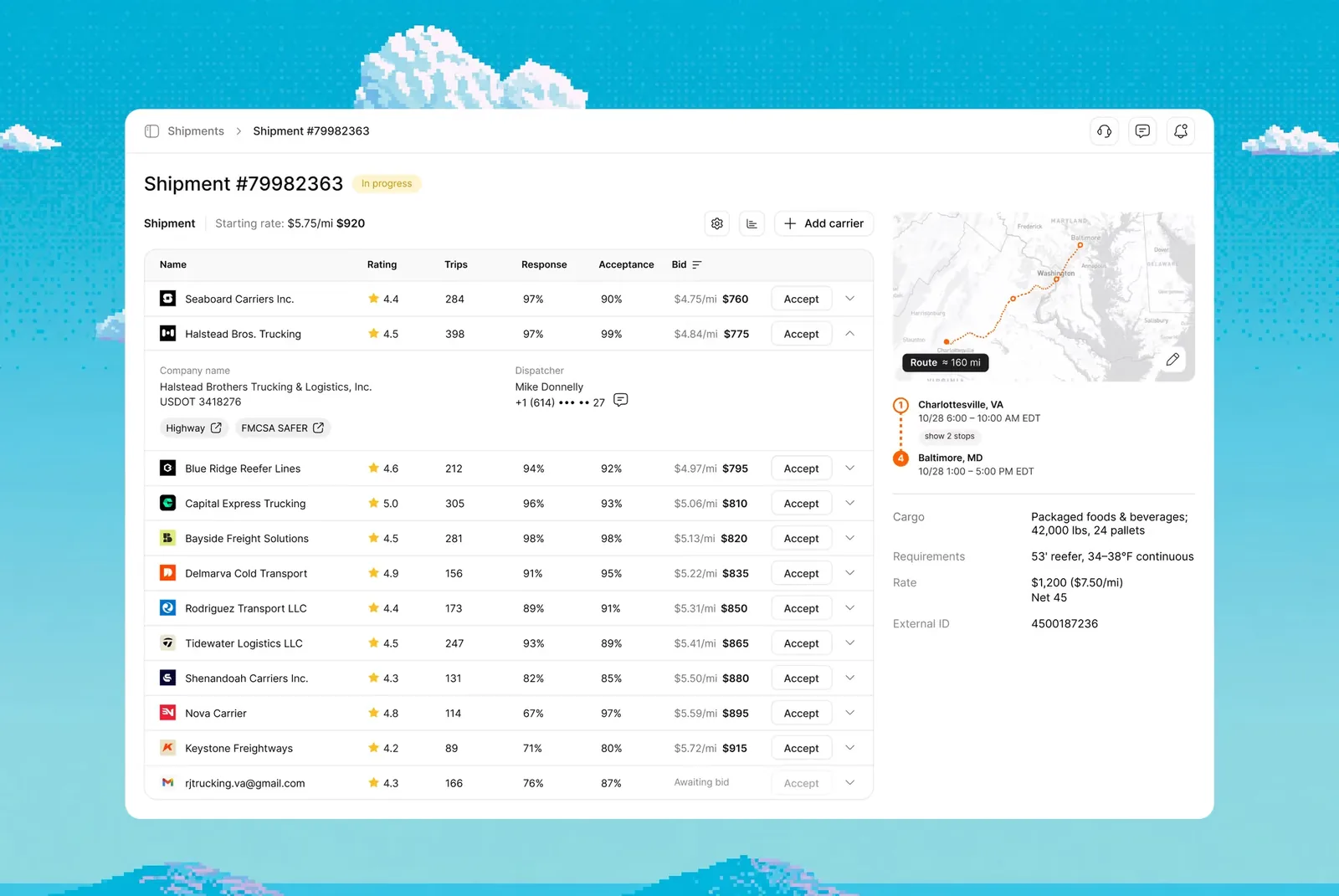
Lanes then handle repeat FTL routes, keeping a routing guide for each lane with first, second, and third choice carriers along with their contract rates. A rejection moves the load down the guide before it goes to open bidding, which keeps contract freight on contract rates for as long as the guide holds.
And when a rejected load falls to a carrier you haven’t worked with, Carrier Network makes sure to check its license, insurance, and company data, and flag lapsed documents before the carrier gets booked. Your team always has the final say-so on who joins your network.
Post your next FTL load once and compare every carrier’s bid in one list — explore Cargofy for FTL.
Before You Tender Your Next FTL Load
Start with the lanes you ship most often by putting a primary carrier and at least two backups on each one. Make sure to agree on any accessorial terms before the first load moves, and send complete load details with every tender. For everything else, try to always book 2 to 5 days out when possible, and compare every quote on its all-in price, with fuel and accessorials included. This way, full truckload shipping stays a predictable cost instead of a weekly scramble for trucks.