

Spot Rates vs Contract Rates: A Shipper’s Guide to Spot Freight Rates


Most truckloads you ship are priced in one of two ways. They either move at a fixed contract rate you agreed with a carrier months ago, or on a spot freight rate set by whatever the market charges on the day you need the truck.
Depending on which of the two a load ends up on, the same lane can cost very different amounts. Transportation budgets are usually built on contract rates, but plenty of loads end up moving at spot rates for various reasons instead, and this year spot rates climbed well above contract rates.
This guide explains what each rate is, how they differ, how to check a spot quote, and how to decide which lanes go on contract and which stay on spot.
What Is the Spot Rate in Trucking?
A spot quote is the one-time, all-in price a carrier or broker charges to move a single load right now, based on what the market pays on that exact lane on that exact day. Neither side commits to any volume, and the price isn’t reserved for next week’s load, so the next quote on the same lane can come back higher or lower.
The trucking spot market works one load at a time — you post the shipment to a load board or send it to a broker or a carrier network, carriers then send back their prices, and you book the carrier whose quote you accept.
Spot freight is usually short-notice, one-off, or seasonal, or it’s a load your contract carriers couldn’t take on. Spot quotes also normally come all-in, fuel included, while contract rates will often split the base rate and the fuel surcharge.
What Are Contract Rates?
A contract rate is a fixed per-mile or per-load price on a specific lane, agreed with the carrier for 3 to 12 months. Most shippers will set them in an annual RFP held between Q4 and Q1, and they price them as a base linehaul rate plus a fuel surcharge that moves with the weekly DOE diesel average. The carriers you award each lane to go into your routing guide, a ranked list with the primary carrier first and the backups behind it.
The catch is that a contract locks in the price, not the truck. And when it comes to long-term truckload contracts, MIT research found that only the price is binding, so the carrier can still reject a load and you can still ship less than you promised. The same paper cites data showing that loads pushed to backup carriers end up costing 9% to 12% more than the contract price, and loads pushed to spot end up costing 23% to 35% more. That’s also why tender acceptance matters as much as the rate when you award a lane.
In many teams, the routing guide still lives in spreadsheets, so when the primary carrier rejects a load, someone has to work through the backups by phone and email, and under time pressure, that load often ends up on spot at a higher price.
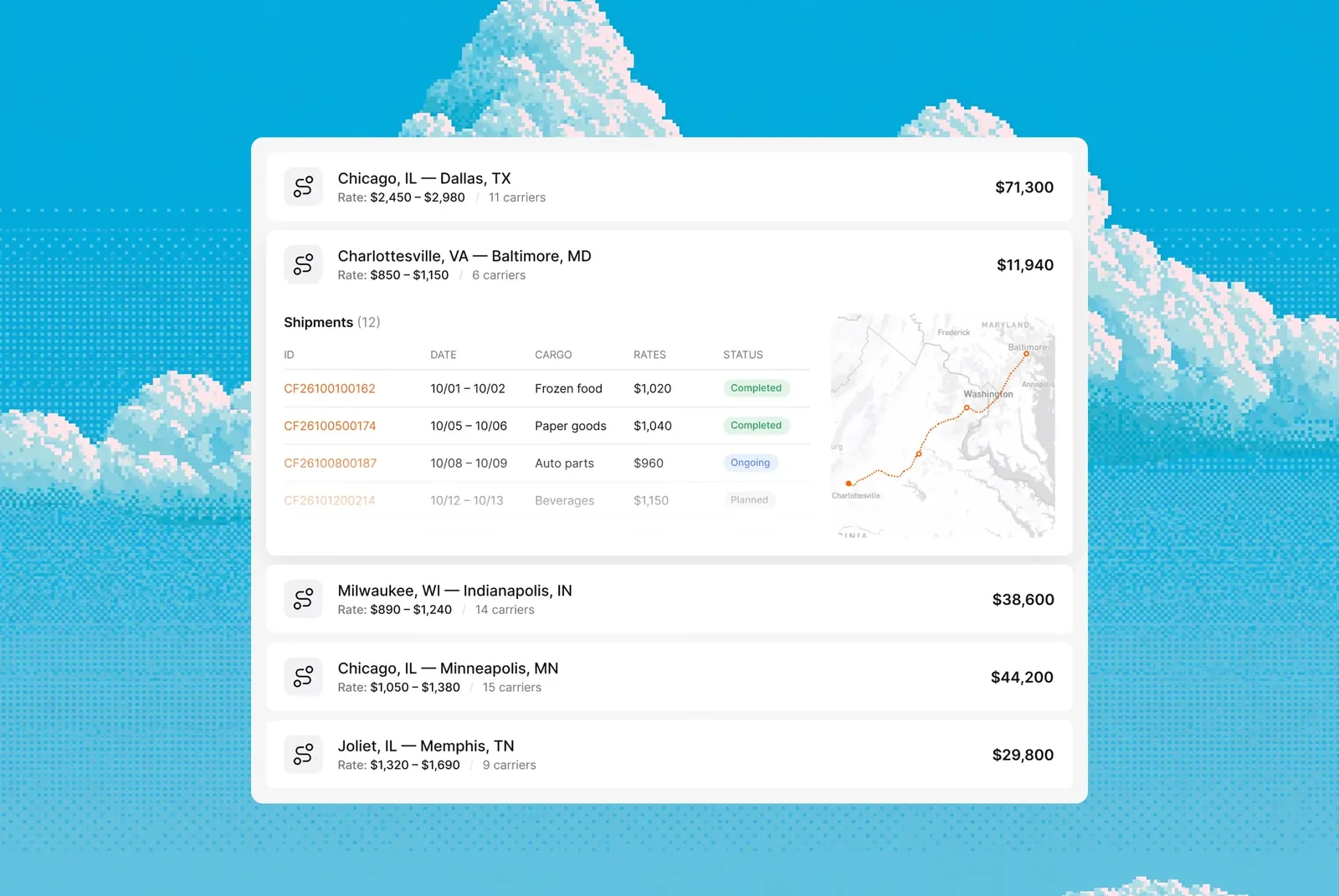
With Cargofy’s Lanes, each route’s contract rate sits next to its first, second, and third choice carriers, and a rejected load moves to the next carrier on the list before it ever goes to open bidding.
Spot vs Contract Rates: What’s the Difference?
The main difference is timing, since a contract rate is set months before the load moves, and a spot rate is set close to the day it moves. Besides that, the contract buys you predictability, and spot buys you flexibility:
| Contract rate | Spot rate | |
|---|---|---|
| How it’s set | RFP or bid, awarded per lane | Quoted per load at today’s market |
| Term | 3 to 12 months | One load |
| Fuel | Base rate plus a fuel surcharge | Usually all-in |
| What’s guaranteed | The price, not the capacity | Nothing beyond the booked load |
| How fast it reacts | At the next bid | Daily |
| Best for | Steady, repeat lanes | One-off, irregular, or overflow loads |
Spot vs contract rates also follow a market cycle, and spot moves first. Spot rates change every day with supply and demand, while contract rates only change when shippers rebid their lanes, so contract prices usually catch up with spot a quarter or two later.
When capacity is loose and carriers have more trucks than loads to fill, spot market rates may even fall below contract rates, so shippers can pay less by booking some loads on spot. On the other hand, when capacity tightens, spot rates climb above contract rates, carriers start rejecting contract loads to haul better-paying spot freight, and freight rates go up across the board at the next bid.
Where Trucking Spot Rates Stand Right Now
Truckload spot rates climbed 52% year over year to $3.56 a mile, according to FreightWaves SONAR November 2026 data. Contract freight rates rose 25% to $2.88 a mile, a 52-week high, but they still trail spot. That puts current freight rates per mile on spot about $0.68, or roughly 24%, above contract, while a year ago the two were almost level.
The same update puts tender rejections at 12.88%, roughly double the level of a year earlier. In practice, carriers are turning down about one in eight contract loads, all of which then go to a backup carrier or to the freight spot market, usually at a higher price.
Freight rates have already gone up this year, and contract rates are still catching up. At the next bid season, expect carriers to push for higher contract rates, and expect more rejections on lanes where your contract rate sits well below current trucking spot rates.
How Spot Rates Are Set and How to Check a Spot Quote
Spot rates are set by the balance of loads and trucks on a lane on a given day. When more loads than trucks need to leave a market, carriers raise their prices, and when trucks outnumber loads, quotes drop.
A few factors move a quote on top of that balance:
- Destination: carriers charge more to deliver into markets where it’s hard to find a backhaul home.
- Lead time: a load tendered for tomorrow costs more than one booked days ahead.
- Equipment: reefer and flatbed loads run higher than dry van ones.
- Season: produce season and the holiday peak push spot market freight rates further up.
- Diesel: fuel sits inside an all-in spot quote, so a jump at the pump shows up in the price right away.
Here’s how to calculate the spot rate on a quote, so you can compare it to your contract:
- Linehaul: multiply the per-mile rate by the loaded miles.
- Fuel: check whether the quote is all-in. If it isn’t, add the fuel surcharge for that week.
- Accessorials: add what you expect to pay for detention, extra stops, or lumper fees.
For reference, at the $3.56 rate above, a 600-mile load comes to about $2,140 before any accessorials. Compare it to your contract on the same basis, which means the contract base rate plus that week’s fuel surcharge, never an all-in spot quote against a linehaul-only contract number.
When Shippers Should Use Spot vs Contract Rates
Make the call one lane at a time instead of setting one policy for the whole network. A contract pays off on lanes that ship enough freight to keep a carrier committed, and most networks have only a few of those.
In another MIT study, low-volume lanes that are still busy across the market (what the study calls backhaul and sparse) made up about 53% of a shipper’s lanes but only 9% of its volume, while its high-volume lanes (balanced and headhaul) had at least 8% higher primary carrier acceptance.
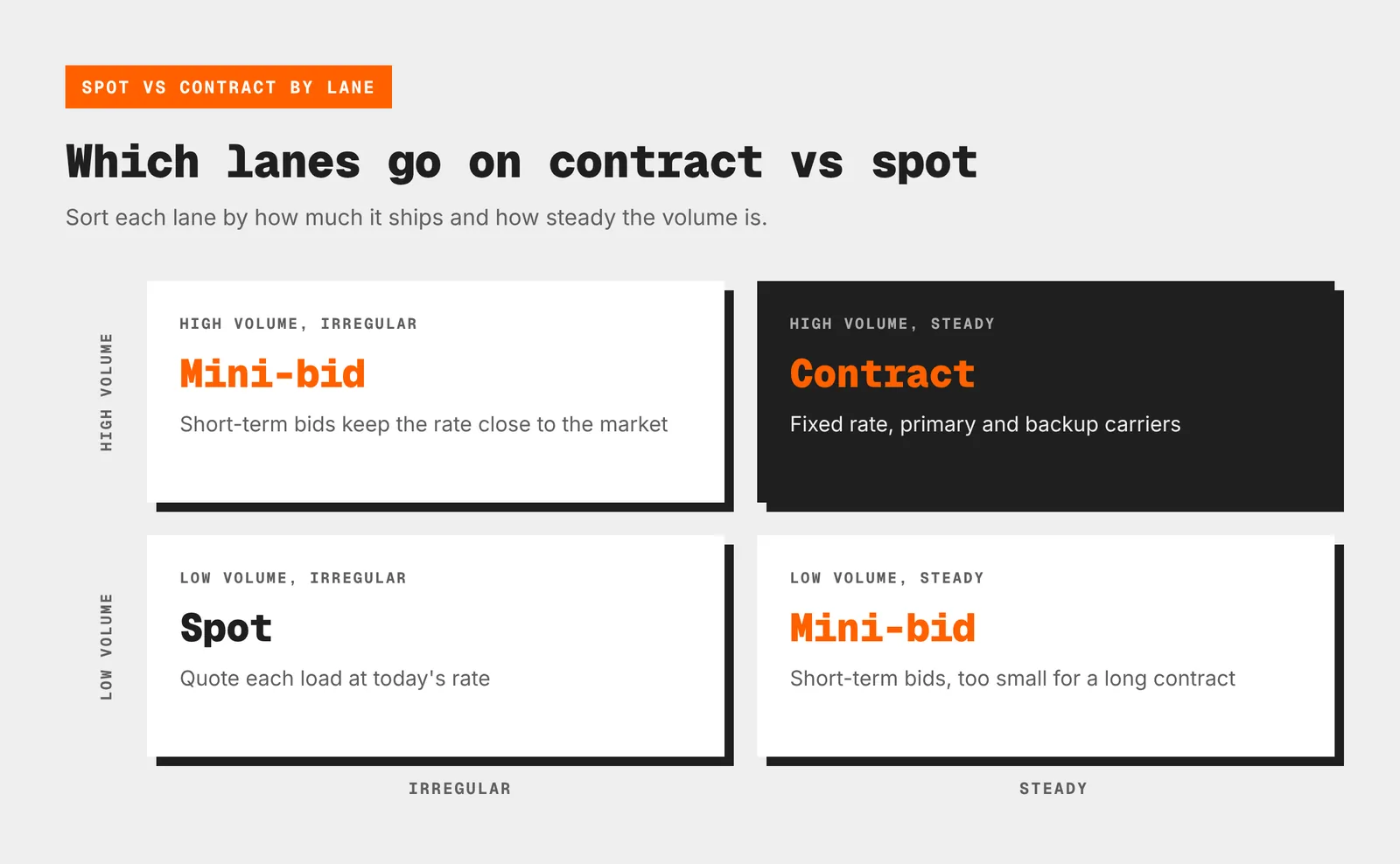
Put these on contract:
- lanes that ship every week or more often, with steady volume
- freight that needs specific equipment or service levels
- lanes where you need a fixed number for the budget
- dense lanes in a tightening market, before spot pulls contract prices up
Leave these on spot:
- one-off and irregular loads
- new lanes until the volume is proven
- seasonal surges above your contracted volume
- overflow after the routing guide runs out
On volatile lanes, where spot prices can swing a lot from month to month, three- or six-month contracts or mini-bids keep the price close to the market, as long as each one runs as a proper freight tender with enough carriers bidding.
Make sure to track how many loads on each lane fall to spot every week, because a rising share is a clear sign that the contract rate sits below market. The spot freight rate you pay on that lane also becomes your benchmark for its next contract.
How Cargofy Handles Spot and Contract Freight
A contract rate only saves money if a rejected load reaches your backup carriers before it falls to spot, and that’s the job Cargofy takes care of. Every repeat lane holds a routing guide with its first, second, and third choice carriers at their own contract rates, plus the lane’s past loads, rates, and carriers. When the primary rejects, the load moves down the guide before it goes to open bidding, which is how 80% of repeat loads get booked at the contract rate.
When a load does go to spot, or when you run a mini-bid, it becomes a tender in Freight Procurement. The tender goes to your contracted carriers first, then the Cargofy network, then load boards, and every bid lands in one list, whether it comes from a carrier’s account, email, a messenger, or a call with your AI Digital Worker.
You set a target rate that blocks higher bids and a bid step, so each new bid has to undercut the last one by a set amount, and your team ultimately picks the winner. Every winning rate is then saved by lane, so what you pay on spot this quarter is already on file when the next contract bid comes around, and your benchmark for it builds up with every load.
Keep repeat lanes on contract rates by sending every rejected load to your backups before it goes to spot — explore Lanes.
Before Your Next Bid Season
Pull the last 12 months of loads by lane from your TMS or freight spot rate software, and mark which ones moved to spot and why. Contract the dense, steady lanes at a rate close to today’s market, leave the sparse ones for spot or mini-bids, and make sure to line up at least two backups behind every primary. When quotes start coming in, compare each spot freight rate with your contract on the same all-in basis, and you’ll know exactly which lanes are costing you more than they should.